
-
Services
Development
- Solutions
- Industries
- Our Work
- Blog
- Company
- Free Tools
- Contact Us

Featured Case Study


Featured Content

 Get in touch
 Request a
Enterprise Solutions
Business Process Streamlining SoftwareDatacon AI
AI Decision IntelligenceWhite Label LMS Platform
AI-Powered White Label LMS for Seamless E-Learning & Course SellingImmigration Case Management Solution
Immigration Automation & Compliance SoftwareFurniture eCommerce Solution
Online Selling Solution for FurnitureCabinets eCommerce Solution
Online Selling Solution for Custom Cabinets and WardrobesSell Appliances Online
AI Powered Ecommerce Solution for Selling Appliances Online


























Tarvinder Singh
- Saas
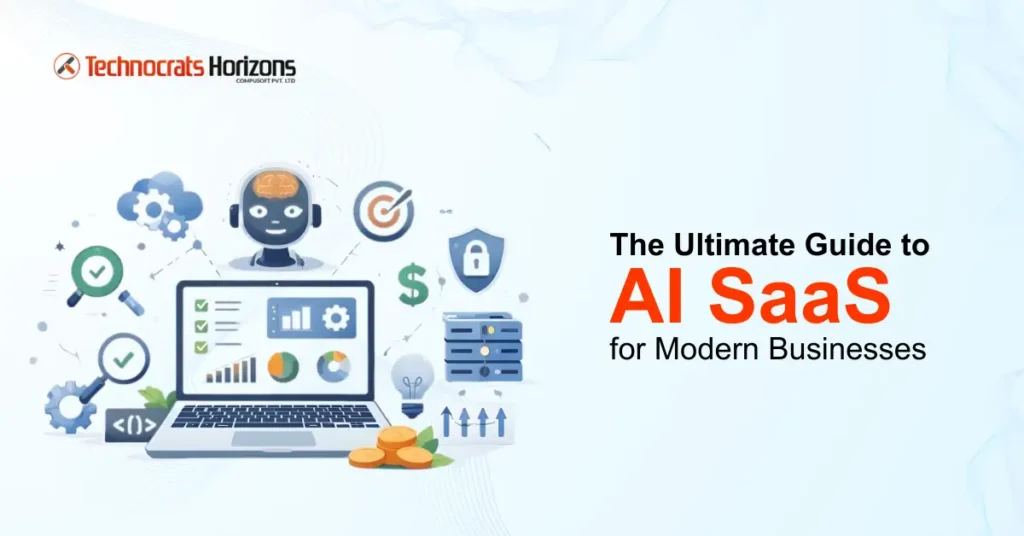
AI SaaS refers to cloud-based software platforms that integrate Artificial Intelligence capabilities such as machine learning (ML), neural language processing (NLP), predictive analytics, and computer vision into their core operational functions.
AI SaaS solutions are crafted to collect data, adapt to changing conditions, and make intelligent decisions with minimal human intervention, in contrast to traditional SaaS, which relies on fixed rules and logic. SaaS platforms can be accessed over the internet, do not require on-premises infrastructure, and are continually maintained by the provider.
In simple terms, AI SaaS integrates:
- The scalability as well as the accessibility of SaaS
- The power and intelligence of AI
This enables companies of all sizes to use modern AI technology without having internal data science teams or expensive infrastructure.
Key Features of AI SaaS Platforms!
Though AI SaaS tools vary by industry and use case, they share a few fundamental attributes that differentiate them from traditional SaaS applications.
-
Machine Learning and Continuous Improvement
Machine learning models installed in AI SaaS systems improve as more information is processed. This means that automated forecasts and suggestions become more precise over time.
-
Automation of Complex Tasks
AI automation in SaaS reduces manual effort by leveraging chatbots to automate document processing for customers. It does this by tackling routine or data-related tasks with ease.
-
Real-Time Data Analysis
AI-powered SaaS tools can analyze massive datasets in real time, speeding decision-making and proactive problem-solving.
Unlock AI-powered growth for your business
-
Natural Language Processing (NLP)
A variety of AI SaaS solutions can easily detect and generate human language, thereby enabling features such as chatbots, data analysis and sentiment generation, and voice assistants.
-
Scalability and Cloud Accessibility
As with traditional SaaS, AI SaaS platforms are cloud-based, enabling them to scale up and down in line with business needs without additional infrastructure.
-
Integration Capabilities
The majority of AI SaaS tools seamlessly integrate with traditional software ecosystems, such as ERPs, CRMs, marketing platforms, and analytics tools.
Benefits of AI SaaS for Businesses!

The rapid adoption of AI SaaS is driven by the benefits it delivers across industries. Here are some major advantages:
-
Lower Barrier to AI Adoption
AI SaaS has removed the need for companies to build AI systems from the ground up. Businesses can access advanced AI capabilities through subscription-based contracts, thereby reducing upfront costs and technical complexity.
-
Improved Efficiency and Productivity
AI SaaS helps teams focus on high-value tasks by automating workflows and reducing the need for manual intervention. This results in faster task completion and increased overall efficiency.
-
Data-Driven Decision Making
AI SaaS tools convert raw data into actionable insights to help businesses make informed decisions by leveraging trends, predictions, and patterns rather than making assumptions.
-
Enhanced Customer Experience
With individualized suggestions and 24/7 AI-powered assistance, AI SaaS enables businesses to deliver a faster, more customized, and consistent user experience.
-
Scalability and Flexibility
AI SaaS platforms can scale with minimal effort as they meet increasing business requirements; it does not matter whether they are managing a large number of users, processing larger data sets, or expanding into new markets.
-
Continuous Innovation
Since AI SaaS businesses regularly refresh their software and models, they automatically benefit from the latest advancements without having to handle upgrades themselves.
Start using intelligent SaaS today
Real-World Examples of AI SaaS
AI SaaS is already deeply integrated across a variety of industries. Below are some typical examples of integrations currently in place. Take a look:
-
Customer Support and Chatbots
AI SaaS platforms power intelligent chatbots that handle customer questions and issue rectification, and can also complicate cases by increasing response speed and reducing support costs.
-
Marketing and Sales Automation
SaaS systems equipped with AI capabilities calculate lead conversion rates, optimize campaigns, analyze customer behaviour, and enhance outreach flexibility.
-
HR and Talent Management
AI SaaS solutions help HR teams make unbiased, worker-centric, data-driven choices, from resume screening to analyzing employee engagement.
-
Finance and Risk Management
AI SaaS platforms are widely used to detect fraud, perform credit scoring, forecast financials, and categorize expenses.
-
Product Design and E-commerce
Customer satisfaction and operational efficiency can be improved in both manufacturing and retail by leveraging AI SaaS to enable product customization, demand forecasting, and intelligent suggestions.
Why AI SaaS Is the Future of Software
The fusion of SaaS and AI is a major shift in how software can provide value, not just a trend. Companies are seeking solutions that aren’t just functional but also smart and flexible as data volumes and customer demands increase.
- AI SaaS empowers organizations to:
- Innovate faster
- Perform more efficiently
- Make smarter decisions
- Be competitive in an ever-changing digital landscape
As AI models become more advanced and widely available, AI SaaS will continue to explore new avenues for businesses to design and deploy technology-oriented solutions.
To Sum Up!
It’s no surprise that AI-powered SaaS is no longer optional but essential for modern businesses. Organizations that invest in SaaS development with AI capabilities are better positioned to innovate, adapt quickly to market changes, and make data-driven decisions. By integrating intelligent SaaS solutions, businesses can improve efficiency, enhance customer experiences, and stay competitive in an increasingly digital and technology-driven environment.
Boost efficiency with AI SaaS solutions
Develop your SaaS product now!
Get a free consultation to build a successful SaaS product tailored to your requirements.